

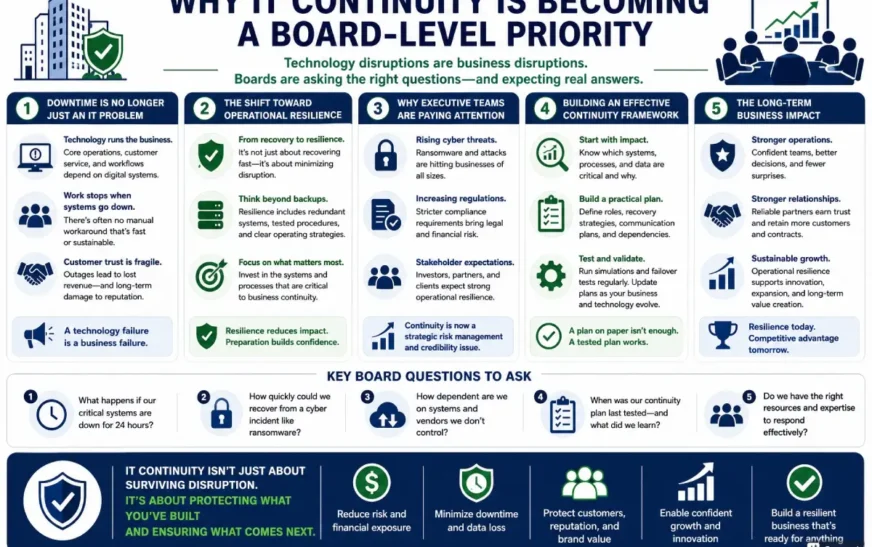
A few years ago, IT continuity was a technical concern. Something the IT department worried about. Something that appeared in infrastructure audits and disaster recovery plans that leadership signed off on without fully reading.
That’s changed. Executives who once trusted that IT would handle IT are now asking pointed questions in quarterly reviews: What happens if our systems go down for 24 hours? What’s our recovery time if we get hit by ransomware? How dependent are we on infrastructure we don’t control?
IT continuity has moved from the server room to the boardroom — and understanding why tells you something important about how business risk has evolved.
Downtime Is No Longer Just an IT Problem
The reason IT continuity has become a leadership concern is straightforward: technology is now embedded so deeply in business operations that a technology failure is a business failure.
This wasn’t always true. Twenty years ago, many businesses could absorb a server outage because critical work could continue manually, at least for a while. Orders could be taken by phone. Records could be accessed from paper backups. Meetings could happen without video conferencing.
Today, most organizations don’t have that fallback. Their customer-facing operations run on software. Their internal workflows depend on cloud platforms. Their teams collaborate through digital tools. When the technology stops working, the work often stops with it — and in ways that aren’t just inconvenient but financially damaging.
Customer trust is particularly fragile in this environment. A business that’s unreachable during an outage doesn’t just lose that transaction. It loses something harder to rebuild.
The Shift Toward Operational Resilience
The framing has shifted from “how do we recover from failures” to “how do we build systems that don’t fail operationally.” These are different questions with different answers.
Recovery planning is essential, but it’s defensive — it assumes the failure has already happened and asks how fast you can get back. Operational resilience asks a better question: what would it take for a disruption to not meaningfully interrupt your business?
This requires thinking about redundancy differently. Not just data backups, but redundant systems. Not just a disaster recovery plan, but tested procedures for operating through different types of disruptions. Not just a recovery time objective, but an honest assessment of what your organization can actually tolerate.
Strong it continuity planning helps organizations minimize disruptions and recover faster from unexpected events — but the most sophisticated version of this planning isn’t about speed of recovery. It’s about reducing the operational impact before recovery is even necessary.
Why Executive Teams Are Paying Attention
The shift in awareness at the leadership level has several drivers, and they’ve compounded on each other over the last few years.
Cyber incidents are the most visible. High-profile ransomware attacks on businesses of all sizes — including organizations that seemed too small or too obscure to be worth targeting — made continuity planning suddenly feel personal. It’s easy to dismiss downtime risk in the abstract. It’s harder to dismiss after your industry peer’s operations were paralyzed for two weeks.
Regulatory pressure is another driver. Depending on the sector, the requirements around data protection, incident response, and business continuity have tightened. Compliance isn’t just an IT checkbox — it carries legal and financial exposure that sits squarely in the executive risk register.
And there’s the operational transparency that modern business demands. Investors, partners, and major clients increasingly ask about operational resilience as part of due diligence. Being unable to demonstrate a coherent continuity strategy is no longer just a technical gap — it’s a credibility gap.
Building an Effective Continuity Framework
An effective continuity framework isn’t a document. It’s a set of tested, maintained capabilities that the organization can actually execute under pressure.
That distinction matters because many businesses have continuity plans that exist primarily on paper. They were written during an audit cycle, filed, and never revisited. The procedures reference systems that have since been replaced. The contact trees include people who left the company. The recovery time objectives were set aspirationally rather than tested in practice.
A functional framework starts with an honest business impact analysis — understanding which systems, processes, and data are truly critical and what the actual cost of losing them for various durations would be. From there, you can prioritize investment in resilience appropriately, rather than spreading attention evenly across everything.
Testing is non-negotiable. The only way to know whether your continuity plan will work is to exercise it. Tabletop simulations, planned failover tests, and incident response drills all serve this function. They also build organizational muscle memory — the ability to respond without chaos when a real incident occurs.
The Long-Term Business Impact
Organizations that invest in IT continuity systematically don’t just recover faster from incidents. They operate differently in normal conditions too.
When teams have confidence in their systems and clear procedures for disruptions, the cognitive overhead of uncertainty goes down. Decision-making improves. Risk tolerance for growth initiatives increases, because leadership knows the operational foundation is solid.
There’s also a compounding advantage in relationships. Clients and partners who’ve seen an organization navigate a disruption professionally — communicating clearly, maintaining service levels, recovering quickly — come away with more confidence, not less. A handled incident can strengthen a relationship in ways that smooth sailing never does.
IT continuity used to be treated as insurance — something you bought and hoped never to use. The businesses building genuine competitive advantage out of operational resilience have figured out that it’s actually infrastructure. Not a hedge against downside, but a platform for sustainable growth.
That’s why the conversation has moved to the boardroom. And why the organizations that treat it as a technical afterthought are increasingly at a disadvantage to the ones that don’t.
Also Read: Reasons Your Dental Practice Is Struggling Online (And How to Change This)